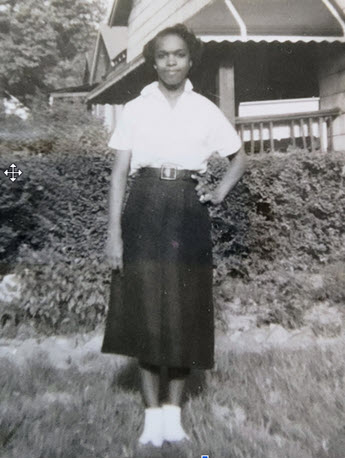
By Wood Alter. What are the forces that act on a human life? Our emotions? Intention? Chance? What were the forces acting on Laidye (Adelaide Askew) — born in Atlanta April 19th, 1940; grew up on Hooper Street; moved to Dubuque, Iowa, for the last two years of college at Dubuque University (her first two years spent at Clark in Atlanta, but she “partied a little too much, so they had to get [her] out of the city”); lived in Chicago for 26 years (a time which included the birth of her daughter); moved to Stone Mountain for a couple of years in the ‘80s before moving to Nashville in 1989 for her daughter’s college enrollment — when on November 30, 2025, visiting family for Thanksgiving, she approached a historical marker on Hooper St (it became Avenue later) with her daughter, Tonce (Tonceola)?
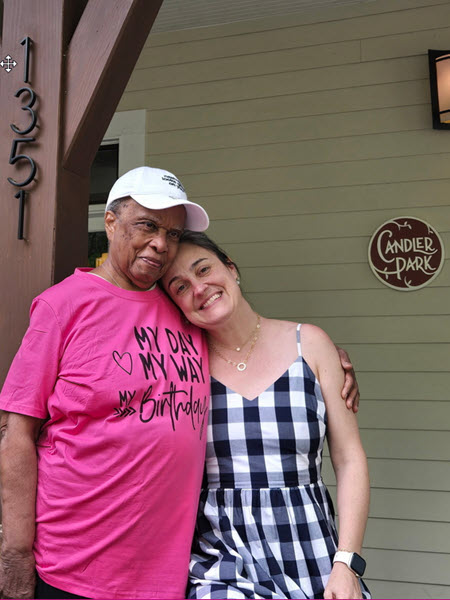
Sarah Cusick — born in Atlanta, moved to Madison, Wisconsin, for college in 1997, moved around from North Carolina to Athens, and eventually called New York home for the 17 years from 2006 to 2023 (a time which included the birth of her two daughters), before moving to Candler Park in 2023 — took her dog for a walk on a chilly afternoon on November 30, 2025, when she noticed two women reading a nearby historical marker. Sarah offered to take the women’s picture in front of the historical marker and was surprised to learn that Laidye grew up at 1351 Hooper Street, the same address at which Sarah had lived since moving back to Atlanta two years before.
A chance encounter led to a burgeoning friendship between Laidye and Sarah, and at some point during their correspondence Laidye shared she would love to spend her 86th birthday (April 19, 2026) in that house that stood where her childhood home had once sat. Sarah was happy to oblige, feeling that the space was no more hers than it was Laidye’s.
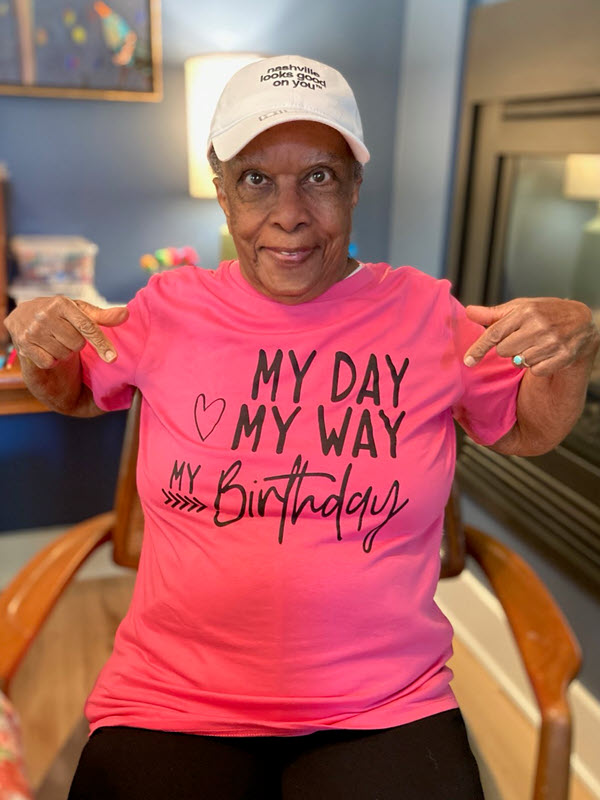
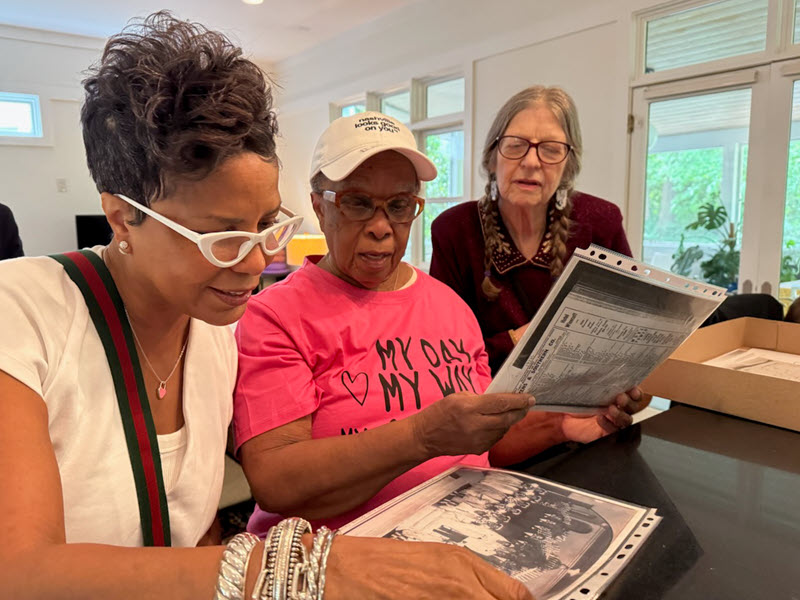
The morning of the celebration on April 19, 2026, was sunny and chilly, an outlier from the simmering days that surrounded it. The night before had included a handful of people at dinner, and Laidye wanted that Sunday to be “low-key” as well. For her 85th birthday the year before, she had 85 guests in attendance. This year people gathered around Sarah’s bright kitchen where Laidye sat at the counter studying a blown-up image of the Juanita Askew Green wedding ceremony at the Antioch East Baptist Church in 1948 — the same church Laidye was baptized in some years prior. “That’s my cousin, that’s my cousin!” Laidye exclaimed, delighted at the image brought by Edith Kelman, courtesy of the Candler Park BiRacial History Project.
Jasmyn Clark, a participant with the BiRacial History Project, is a sixth generation descendant of the Lattimores who were a founding family of the Antioch East Baptist Church and Rose Hill Community home owners. She looked at the picture with Laidye and exclaimed, “Y’all used to have a good time!”
“All the time!” Laidye laughed in response. Laidye shared about her time growing up in the neighborhood. She reflected on the community in the area, saying “…it truly was a village.” Laidye explained that if a neighbor saw you misbehave as a child, they’d reprimand you on the spot, and you better believe your parents would hear about it, too. “I was a tree climber,” Laidye said. “We used to swing on the kudzu vines.”
More of Laidye’s family filtered in over the course of the morning, including her daughter Tonce (after singing happy birthday to Laidye on the phone earlier), her niece Cia from Palmetto, and her second cousin Cherie from East Point. While the women had all spent time together in the past, never before had all of them been at 1351 Hooper Street. Yet here they were, celebrating Laidye’s 86th birthday on the plot she used to call home.
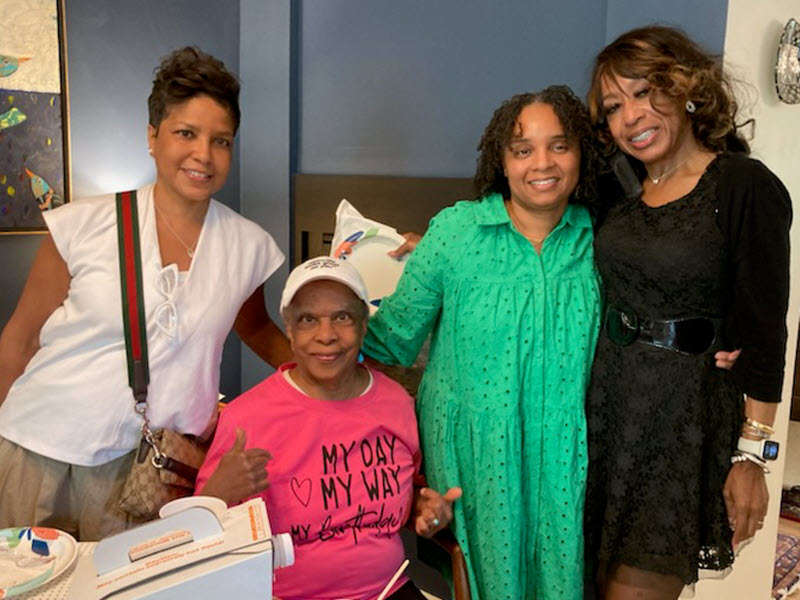
Surely there is more to life than a line traced across space through time, our bodies merely particles traveling paths dictated by forces outside of our control. Each position on that curve, extended over 86 years, was a moment of time in Laidye’s life. No words on a page could fully capture the history of Laidye’s experience on this earth, much less the lives of all of those in attendance that pleasant spring morning. The glimpses given into Laidye’s childhood through conversation serve as reminders that we will never know the totality of another’s experience; the fallibility of memory dictates we will never remember the entirety of our own.
The same could be said for the places we occupy in this journey — Candler Park, though still here in the 86 years that elapsed, is a different neighborhood now than it was then. The house at 1351 Hooper Street is not the same house that Laidye grew up in. The old stone church, the hand-built sanctuary of the Antioch East Baptist Church pictured in the wedding photo Laidye admired at the kitchen counter is now the location of the First Existentialist Congregation. Everything changes.
This article does not even scratch the surface of the complexity of the history of this neighborhood, nor the complexity of the history of Laidye’s life. For more details on the former, the Candler Park BiRacial History Project offers a wealth of information (https://biracialhistoryproject.org/). For more details on the latter, your best bet is through conversation with Laidye. If there is one thing I learned in my brief time interacting with her, Laidye loves to share.